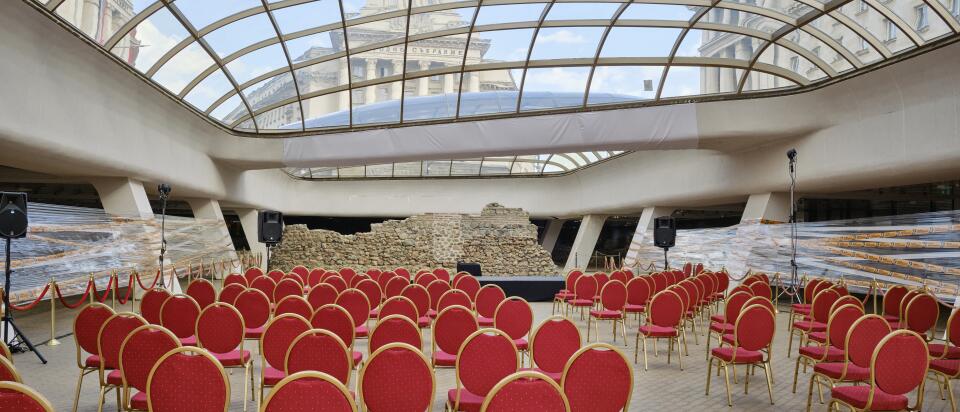
New safety requirements, restructured responsibilities, a complete overhaul of restroom standards, and streamlined bureaucracy – Germany's Model Assembly Venue Ordinance (Muster-Versammlungsstättenverordnung, or MVStättVO) is undergoing its most comprehensive revision in two decades.
The draft, published by Germany's Building Ministers' Conference (ARGEBAU) in February 2025, will reshape how event venues are built, operated, and regulated across the country. Hamburg is already leading the way, with its own updated ordinance taking effect on January 1, 2026. For anyone who plans events, operates venues, or manages safety concepts in Germany, these changes demand attention.
How Germany's Assembly Venue Regulations Work
Before diving into the specifics, a brief but important explanation of how venue regulations work in Germany – because even experienced event professionals frequently find this confusing.
Germany does not have a single, nationally binding assembly venue ordinance. Instead, the system operates on two levels: The Building Ministers' Conference (ARGEBAU) develops a Model Assembly Venue Ordinance (MVStättVO), which serves as a recommendation and framework. The currently applicable model dates back to 2005, with the last amendments made in 2014. However, this model ordinance only becomes legally binding once an individual federal state (Bundesland) adopts it into state law – and this is where the complexity begins.

Planning nationwide means: individually reviewing each state law.
Each of Germany's 16 federal states has its own version. Some adopt the model ordinance nearly verbatim, while others deviate on specific points. Brandenburg, for example, has implemented the MVStättVO as the Brandenburgische Versammlungsstättenverordnung (BbgVStättV), while Berlin takes a different approach entirely with its Betriebsverordnung (BetrVO), integrating assembly venue requirements into a broader operational regulation.
In practice, this means that anyone planning events across multiple locations in Germany needs to verify which version of the ordinance applies in each state. The core principles are consistent across most states since they share the same model – but the details can make a significant difference.
What's Happening Now: A Federal-Level Overhaul
Here's where things get interesting: In February 2025, the Building Ministers' Conference published a draft for a comprehensive revision of the MVStättVO – the first fundamental overhaul since the 2005 version. Once finalized as a model, this draft will serve as the basis for individual states to update their respective ordinances.

Moving away from rigid building regulations, towards flexible safety concepts.
Hamburg has already moved ahead, developing its own updated version aligned with the model revision, set to take effect on January 1, 2026. Other states are expected to follow once the model ordinance is finalized at the federal level.
This means the changes outlined below don't just affect one state. They signal the direction in which venue regulation across all of Germany is heading.
The Key Changes in Detail
| Area / Topic | What is Changing? (Core Fact) | Consequence for Practice |
|---|---|---|
| Scope of Application | Change of term from "sports stadiums" to "stadiums." | Same safety standards for all events (concerts, shows), not just sports. |
| Capacity (Standing) | 2 persons per m² as the new standard value for other standing areas (gap closed). | Serves as a minimum value. Higher density possible but requires proof in the safety concept. |
| Toilets | Elimination of rigid lists (except Hamburg). Calculation according to VDI 6000 Part 3 (functional). Unisex allowed. | More flexible planning, but often a higher number needed. Hamburg retains modified tables. |
| Safety Concept | Must be submitted in time. Allows deviations from building regulations. | No more "last minute" submissions possible. More flexibility for operational solutions instead of building permits. |
| Evacuation Concept | Becomes a mandatory document (in HH explicitly § 42 from 1,000 people). | Must include scenarios like terror/bad weather and concerns of people with disabilities. |
| Responsibility | Operator bears overall responsibility for the building and event (§ 38). | Clarification: Building permit does not exempt from the safety of the specific event. |
| Bureaucracy Reduction | Elimination of guest performance inspection book and non-public technical rehearsal. | Relief for touring productions. Those responsible for event technology guarantee safety. |
| Accessibility | Quota: 1% (up to 5,000 seats), then 0.5%. Min. 2 seats. | More wheelchair spaces and, due to VDI 6000, usually more accessible toilets required. |
| Technology (Stage) | Fire-retardant curtains/gates permissible as an alternative to the "iron curtain." | More modern fire protection solutions for large stages possible. |
| Smoke Extraction | Stricter requirements (especially Hamburg § 16): Mandatory from 50 m², 600°C resistance. | Higher technical requirements for smoke extraction systems. |
| Wording (Legal) | "Inspection" instead of "search." "Self-acting" instead of "automatic." | Legal certainty for private security services; adaptation to building law terminology. |
What Event Professionals Should Do Now
The revision is underway, Hamburg is already implementing, and other states will follow. Here are the key recommendations:
Monitor developments in your state. The MVStättVO revision sets the direction, but each state implements at its own pace with its own adaptations. If you plan events across multiple states, actively track developments in the relevant state ordinances.
Prepare safety concepts early and thoroughly. The revision sends a clear signal: safety concepts must be submitted in a timely manner, security staff must be trained, and responsibilities must be clearly documented. Those who are professionally organized will simultaneously benefit from the new flexibility provisions.
Don't delay on evacuation concepts. Even if your state doesn't yet explicitly require a standalone evacuation concept, systematic evacuation planning that accounts for various emergency scenarios and people with disabilities is becoming the standard.
Rethink restroom planning. The shift to VDI 6000 Part 3 opens new possibilities – but also new requirements. If you're not yet familiar with this technical standard, now is the time. The option for unisex restrooms can significantly simplify logistics, particularly for temporary events.
Review capacity calculations. The new standing area formula and the possibility of higher occupancy densities require a thorough understanding of the calculation methodology – especially in connection with the fire protection concept.

No longer a 'nice-to-have': Accessibility becomes a fixed standard.
Establish accessibility as standard practice. The new requirements for wheelchair spaces and accessible restrooms set clear benchmarks. Even if you're not immediately affected, use these standards as a guide.
Check your documentation for terminology. The switch from "automatic” to “self-activating," from “sports stadiums” to “stadiums,” and the consistent use of gender-inclusive language affect every document that references the ordinance – from fire protection policies to safety concepts.
Conclusion: More Flexibility, More Responsibility, More Practicality
The revision of Germany's Model Assembly Venue Ordinance is the most comprehensive update in two decades. It doesn't bring a revolution, but a substantial modernization: more flexible restroom planning, strengthened safety concepts, clearer responsibility structures, reduced bureaucracy for touring productions, improved accessibility, and more practical regulation of stadiums.
The clear message from the Building Ministers' Conference is this: operators bear the responsibility – and in return, they receive better tools and greater flexibility. Those who align their processes with the new requirements early on are not only on the right side of the law but are also laying the foundation for more professional and safer events.
Disclaimer: This article is for general informational purposes and does not constitute legal advice. Specific requirements depend on the applicable state ordinance. The MVStättVO draft described (as of February 2025) has not yet been implemented in all federal states. For event planning and execution, we recommend consulting the responsible building authority or specialized legal advisors.